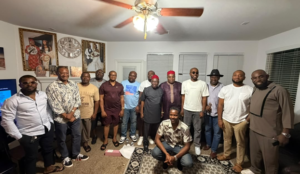
Mazi Okoro calls for deeper study of Igbo-Japanese cultural connections.
4 min read
A Nigerian of Umuaka extraction living in Japan, Mr. Festus Okoro, popularly known as Fetu, has added a fresh voice to the growing international conversation on the striking similarities between the Igbo language and culture of southeastern Nigeria and those of Japan.

Speaking during an interview with Umuaka Times from Japan, Okoro said his years of living and working in the Asian nation have enabled him to observe numerous cultural practices, place names and expressions that closely resemble those of the Igbo people. Although he acknowledged that there is no generally accepted historical or scientific evidence proving a common ancestry between the Igbo and the Japanese, he believes the similarities are too numerous to be ignored and deserve serious academic investigation.

“I have lived in Japan long enough to notice that many Japanese names and customs remind me of home,” Okoro said.
“When I first arrived, I thought it was mere coincidence. But as the years passed, I kept discovering more similarities in language, traditions and even religious practices.”
According to Okoro, one of the most fascinating discoveries has been Japanese towns and cities whose names are identical or remarkably similar to Igbo words and personal names. Among the examples he cited are: Osaka, one of Japan’s largest cities, whose name also exists as a personal name in some Igbo communities. Ugo, a town in Akita. In Igbo, Ugo means “eagle,” one of the most revered symbols representing royalty, honour, courage and greatness.
Some other common Igbo names Okoro disclosed include Ugochukwu, Ugoeze, Ugoamaka and Ugochinyere. Iheya, a village in Okinawa whose pronunciation closely resembles the Igbo phrase “Iheya,” meaning “his property” or “somebody’s property.” There is also Ihechi, an Igbo name meaning the light of God. Several places in Japan bear striking phonetic similarities to words found in the Igbo language. For example, Nara, the capital of Nara local council, has the same pronunciation as the Igbo word “Nara,” which means “receive” or “accept.”
Similarly, Miki, a city in Hyogo local counci, shares its pronunciation with the Igbo word “Miki,” which in some dialectal usage means “to squeeze” or “to press.” Another example is Aso, a well-known area in Kumamoto Prefecture, which is also a personal or family name in parts of Igboland. The Japanese city of Ise in Mie community is pronounced the same as “Ise,” a word meaning “five” or amen in some Igbo dialects. Likewise, Kaga, a city in Ishikawa area, closely resembles the Igbo word “Kaga,” which means “to tie” or “to fasten.”
“They build small shrines where people go to pray and bow before their deities. When I saw it, it reminded me immediately of traditional worship in Igboland,” he said.
He also observed similarities in ceremonies marking important stages of life.
“They have initiation ceremonies into adulthood, just as the Igbo have age-grade and adulthood rites. They also perform foundation rituals before constructing buildings, comparable to customs once practised in many Igbo communities. Even the way newborn babies are celebrated bears some resemblance.”

Okoro’s observations echo discussions that have intrigued historians and independent researchers for decades. However, mainstream scholars continue to urge caution against drawing conclusions solely from similarities in pronunciation or cultural practices. Linguists note that Igbo belongs to the Niger-Congo language family, while Japanese belongs to the Japonic language family, two language groups that are not known to be historically related.
In the cause of research for this story, Umuaka Times came across a document which emphasizes on the findings of Professor Kay Williamson, one of the foremost authorities on Niger-Congo languages, and other comparative linguists who emphasized that similarities in sound alone cannot establish a genetic relationship between languages. Likewise, Japanese linguists have found no accepted evidence linking Japanese to the Igbo language. International scholars also point out that many unrelated languages produce similar-sounding words purely by coincidence because human speech is built from a limited number of sounds.
Similarly, anthropologists have long observed that practices such as ancestor veneration, sacred shrines, initiation rites, purification rituals, and ceremonies associated with building houses and welcoming newborns occur independently in many societies around the world. Comparable traditions have been documented not only among the Igbo and Japanese but also in cultures across China, Korea, India, parts of Southeast Asia, and numerous African societies.
The possibility of cultural similarities between Japan and southeastern Nigeria has attracted interest from independent writers and cultural enthusiasts over the years. Some researchers have highlighted apparent parallels in respect for ancestors, extended family structures, community festivals, traditional titles, and symbolic rituals. Others have explored phonetic similarities between Japanese place names and Igbo words.
However, these observations have not been accepted as evidence of a shared origin because archaeological, genetic, linguistic and historical research has yet to establish any direct ancestral connection between the two peoples. Despite this, scholars generally agree that comparative studies of languages and cultures remain valuable because they deepen understanding of how different societies develop and sometimes arrive at remarkably similar traditions independently.
Okoro said he hopes universities in Nigeria and Japan will collaborate on comparative research into the similarities he has observed.
“I’m not saying the Igbo came from Japan or the Japanese came from Igboland,” he explained. “What I am saying is that there are interesting similarities in language, customs and traditional practices that deserve careful academic research instead of being dismissed without investigation.”

He expressed optimism that future collaborations involving linguists, historians, anthropologists and archaeologists from both countries could help determine whether the similarities are simply coincidences or reflect ancient cultural interactions that have yet to be fully understood.
For now, scholars maintain that while the parallels are intriguing, the current body of historical, linguistic, archaeological and genetic evidence does not support the conclusion that the Igbo and Japanese peoples share a common ancestry. Nonetheless, observations such as those made by Festus Okoro continue to fuel curiosity and encourage further scholarly dialogue between the two cultures.