
Dick Tiger: From bottle scavenger in Aba to world boxing champion. An Umuaka Times Tribute to a Legend.
9 min read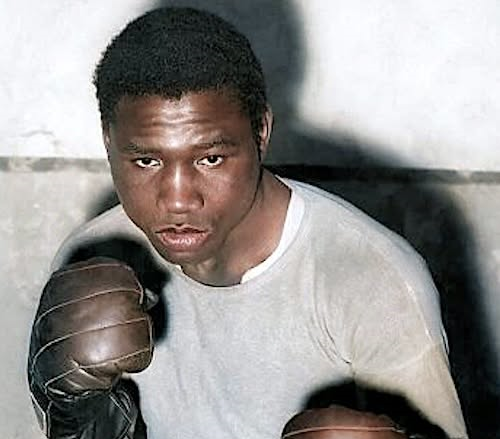
The extraordinary life, struggles, triumphs, Biafran ordeal and final journey of Richard Ihetu remind one that there are some names that refuse to disappear from history.There are men whose achievements become part of the identity of a people, and whose stories continue to be told long after they are gone.

For generations of Nigerians, particularly people of the old Eastern Region, one such name has been Richard Ihetu, popularly known as Dick Tiger, the son of Amaigbo in present-day Nwangele Local Government Area of Imo State who rose from humble beginnings to become one of the most accomplished boxers Africa has ever produced. That Amaigbo town as far back as the 60s had given birth to a son who successfully made his way to Madison Square Garden USA is a story that will always make headlines. Umuaka Times correspondents, in reviewing historical accounts of the legendary boxer, found a remarkable story of poverty, determination, international glory, political controversy, war, sacrifice, illness and an early death.

Tiger’s story was not the story of a man who was born into privilege.It was the story of a young man who fought his way out of hardship like many others. First in the streets and markets of Aba, and later inside boxing rings in Nigeria, Britain and the United States.And at the height of his career, he became a world champion in two weight divisions.
According to what Umuaka Times gathered which is now known as the Dick Tiger Files, Richard Ihetu was born on August 14, 1929, in Amaigbo, in what is today Nwangele Local Government Area of Imo State.He came from a humble background. Accounts of his early life disclosed that the death of his father while Richard was still young, left his mother, Rebecca Ihetu, to help provide for the family.According to the accounts young Richard’s formal education did not take him very far.As a young man, he moved to Aba, a rapidly developing commercial city that would eventually become central to his life and career.
In Aba, Tiger reportedly survived by doing menial jobs, including collecting empty bottles and selling them to warehouses.It was a far cry from the world of international boxing that awaited him.A biographical account preserved by the Biographical Legacy and Research Foundation describes his early bottle-trading work and the difficult social conditions he encountered in Aba.But Aba would also provide the environment in which the young Ihetu began to discover his strength.He became physically strong, developed a reputation for toughness and eventually began boxing.The city that had witnessed his struggles would later celebrate him as one of its greatest sons.
Before he became internationally known as Dick Tiger, Richard Ihetu was simply a young man trying to survive.His physical strength and fearless personality gradually attracted attention.Historical accounts indicate that he began boxing in inter-club contests organized in Nigeria, with British military personnel among those involved in the boxing environment of the period.
BoxRec records that Ihetu began boxing at about 19 and participated in inter-club contests before eventually turning professional.He officially turned professional in 1952.But success did not come overnight.There were defeats.There were setbacks.There were lessons.And there was the difficult task of transforming natural toughness into the discipline required to compete at the highest level.
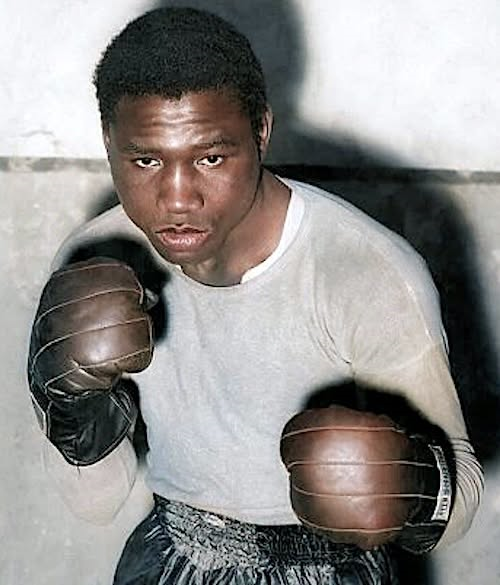
Tiger eventually travelled to Liverpool, England, to pursue his boxing career.For an African boxer of his era, entering the British and later American boxing establishments was a major challenge.He was competing far from home and had to prove that he belonged among fighters who had greater access to established boxing systems.Yet Tiger persevered.His international career eventually took him to the United States, where he would face some of the biggest names in world boxing.The International Boxing Hall of Fame records that Tiger campaigned in Nigeria and England before making his United States debut in 1959.
The defining breakthrough came in 1962.Tiger challenged American champion Gene Fullmer for the world middleweight championship.He won the fight by decision. The world indeed wondered that a young man who had once survived by collecting empty bottles in Aba had become a world champion.It was indeed an extraordinary transformation.The International Boxing Hall of Fame records that Tiger defeated Fullmer in October 1962 to win the WBA middleweight championship. He subsequently became recognized as undisputed champion after defeating Fullmer again in 1963.
Umuaka Times however gathered that his championship journey was not without reversals; he lost the title to Joey Giardello, but returned in 1965 and defeated Giardello in their rematch to regain the crown.That ability to recover from defeat became one of the defining features of his career.
One of the most historic moments in Tiger’s career occurred when he defended his championship against Gene Fullmer in Nigeria.The fight took place at Liberty Stadium in Ibadan in 1963.It was a remarkable occasion.An African-born world champion was defending his world title before a huge home audience on African soil.For Nigeria, it was more than a boxing contest.It was a demonstration that a man from the former colonial territory could rise to the summit of an international sport.
Tiger subsequently moved up from middleweight to light heavyweight.In December 1966, he defeated José Torres to become world light-heavyweight champion.He had now conquered two divisions.The International Boxing Hall of Fame records his victory over Torres and his successful defences before he eventually lost the title to Bob Foster in 1968.
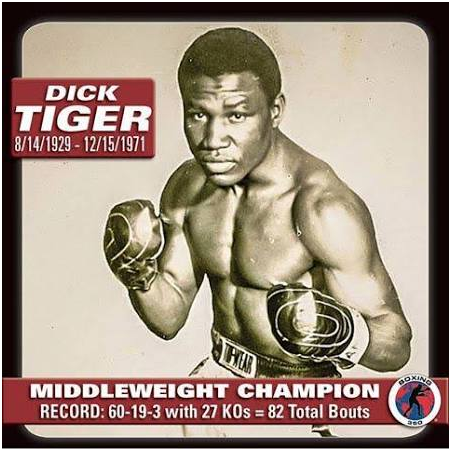
This achievement cemented Tiger’s place among the great fighters of his generation.His professional career ended with a record generally listed at about 60 victories, 19 defeats and three draws, with 27 wins by knockout in commonly cited records.The International Boxing Hall of Fame, however, lists 59 wins and 26 knockouts in its historical record, illustrating a small statistical discrepancy among boxing databases.
Tiger’s achievements did not go unnoticed.The Ring magazine named him Fighter of the Year in 1962 and again in 1965.He was later inducted into the International Boxing Hall of Fame in 1991.For a boxer who had started life in humble circumstances in eastern Nigeria, this was an extraordinary international recognition.He had travelled from Aba to Liverpool, from Liverpool to America, and from relative obscurity to the very top of professional boxing.
Tiger’s life took a dramatic turn during the Nigerian Civil War.The boxer openly supported Biafra and served as a lieutenant in the Biafran forces.His decision had consequences.He was no longer simply a famous Nigerian sportsman.He had become a political and military figure in one of the most painful periods of Nigerian history.Sources describe Tiger as having used his position and resources in support of Biafra, while accounts of his biography say that the war had a significant impact on his finances and his relationship with the Nigerian authorities.His support for Biafra also affected his relationship with Nigeria after the war.For a period, he could not freely return home.A man who had once brought international glory to Nigeria had become politically estranged from the country.
The Civil War changed Tiger’s life.The war ended in 1970.But the emotional and personal consequences continued.His international boxing career was also coming to an end.Tiger’s last professional fight was against Emile Griffith in 1970. He lost the bout and retired from professional boxing.After retiring, he took a job as a security guard at the Metropolitan Museum of Art in New York.The former world champion had moved from the bright lights of championship boxing to ordinaryemployment.But another battle was already beginning.
In 1971, Tiger began experiencing severe pain.According to an account published by Neusroom, he was working in New York when he suffered severe stabbing pains in his back, right side and abdomen. The pain became so intense that he fell to his knees.He was taken to St. Vincent’s Hospital in Greenwich Village, Manhattan.The diagnosis was devastating; liver cancer! The fighter who had survived some of the toughest men in boxing now faced an opponent that could not be defeated with a left hook, right hand or championship strategy. That was cancer and that was terminal! Newspapers across the world reported the news of the diagnosis on their front pages.
With the war over, Tiger wanted to return home.Accounts of his final months say that he expressed a desire to return to his homeland.The Nigerian government eventually permitted him to return.He travelled back to Nigeria and returned to Aba, the city that had played such an important role in his life.Neusroom’s historical account says that thousands of people travelled to Aba to see the dying champion.It was a remarkable reversal of circumstances.Decades earlier, Aba had been the place where the young Richard Ihetu struggled to survive.Now Aba was welcoming home the world champion.
Tiger eventually returned to his hometown, Amaigbo. Sadly, he died on December 14, 1971, at the age of 42.The precise location of his death is reported differently in historical and boxing records. The International Boxing Hall of Fame records his date of death as December 14, 1971, while the detailed Neusroom account states that he eventually died in Amaigbo. Other boxing databases list Aba as his place of death.What is not in serious dispute is the cause:Dick Tiger died from liver cancer.
On December 19, 1971, five days after his death, Dick Tiger was buried in Amaigbo, his hometown.His funeral drew thousands of mourners across Igboland.The New York Times reportedly covered the funeral, describing crowds of mourners who gathered in the town to bid farewell to the former world champion.Thus, the journey that began in Amaigbo came full circle.Richard Ihetu left home as a young man searching for a future.He conquered boxing arenas across three continents.And when his life ended, he was brought back to the soil of his birthplace.
Tiger’s tomb remains in Amaigbo till date.His son, Richard Ihetu Jnr, has spoken publicly about efforts to preserve and develop his father’s burial site.In an interview reported by The Eagle Online, Ihetu Jnr said people still visit the tomb, particularly during December and Easter periods, and expressed the hope that the site could eventually become a tourism and heritage centre.For Umuaka Times correspondents covering the history of Imo State and the wider Orlu Zone, the mausoleum represents more than a grave; it represents the final resting place of a man whose name travelled far beyond the boundaries of Amaigbo.Dick Tiger left behind more than championship belts.He left a story.A story about poverty.A story about courage.A story about ambition.A story about international success.A story about political conviction.A story about war.A story about sacrifice.And finally, a story about returning home.
His son has described him as a family man who was determined that his children would not experience the hardship he suffered as a child. Richard Ihetu Jnr has also recalled his father’s humble beginnings in bottle trading and his insistence that his children remember where they came from.Tiger left behind his wife, Abigail, and eight children.
More than five decades after his death, Dick Tiger remains one of the most important figures in African boxing history.
He was not undefeated.He suffered defeats.He lost world titles.He faced political adversity.He experienced the consequences of war.He became seriously ill at a relatively young age.But each chapter of his life added another dimension to his legacy.His boxing achievements alone were extraordinary.He became world champion at middleweight.He became world champion at light heavyweight.He was named The Ring Fighter of the Year twice.And in 1991, twenty years after his death, he entered the International Boxing Hall of Fame.
Perhaps the most powerful way to understand Dick Tiger’s life is to remember where he began.Amaigbo.Then Aba.Then Liverpool.Then New York.Then the world championship.Then war.Then illness.Then home.Then Amaigbo again.
The young Richard Ihetu who once struggled to make a living in Aba could hardly have imagined that his name would one day be known around the world. A man who left his Amaigbo village as Richard Ihetu and returned home as the world-famous Dick Tiger. The tiger in him indeed dismantled other “wild animals” in the boxing ring. Too bad he died at the age of 42 but the name Dick Tiger did not die with him.
For the people of Amaigbo, Nwangele, Imo State and the wider Igbo community, his story remains part of the history of a generation that produced extraordinary men and women under extraordinarily difficult circumstances.
Umuaka Times correspondents report that the story of Dick Tiger is therefore not merely the story of a boxer. It is the story of a young Nigerian who came from humble beginnings, crossed continents, conquered the boxing world and ultimately returned home to rest in the soil from which he came.