Obi’s 10,000MW Power Promise Sparks Debate Ahead of 2027 Election.
3 min read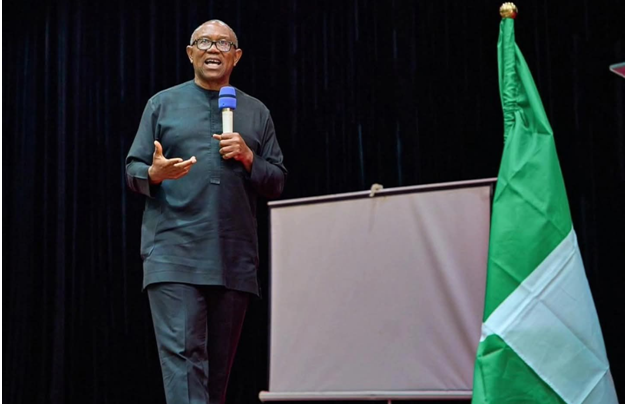
Presidential candidate of the Nigeria Democratic Congress (NDC), Peter Obi, last week ignited a nationwide debate after pledging to increase Nigeria’s electricity generation and distribution capacity to at least 10,000 megawatts (MW) within four years if elected president in 2027. Obi made the ambitious promise on Saturday last week shortly after emerging as the NDC’s presidential candidate at the party’s national convention in Abuja, where delegates formally ratified his candidature as the sole flag bearer of the party for the 2027 general election.

In his acceptance speech, the former Anambra State governor described Nigeria’s electricity situation as a national embarrassment, arguing that the country’s current power output is grossly inadequate for a population exceeding 200 million people. According to him, nearly 100 million Nigerians remain without access to electricity despite the nation’s vast human and natural resources.

“Today, Nigeria is the country with the highest number of people without access to electricity in the world. About 100 million Nigerians do not have access to electricity,” Obi declared.
“In today’s world, it is unacceptable that a nation of over 200 million people generates and distributes only about 4,000 megawatts.
“The biggest economies in Africa, South Africa and Egypt generate more than 40,000 megawatts each. We are not even producing 10 per cent of what these countries generate and distribute, despite having a larger population.
“It is unacceptable, and I pledge that within four years, our government will increase power generation and distribution from the current level of about 4,000 megawatts to at least 10,000 megawatts.”
Beyond power supply, Obi also questioned the credibility of the unemployment figures released by the National Bureau of Statistics (NBS), which placed Nigeria’s unemployment rate at 4.3 per cent in the second quarter of 2024. He argued that the statistics do not reflect the harsh realities faced by millions of Nigerians, particularly young graduates struggling to secure meaningful employment. The former governor pledged to tackle unemployment through aggressive support for small and medium-sized enterprises (SMEs), enhanced investments in productive sectors, and policies designed to stimulate job creation across the country.
However, Obi’s electricity pledge has generated mixed reactions from Nigerians, with supporters hailing the target as bold and achievable, while critics describe it as overly ambitious and difficult to attain within a single presidential term.
The announcement has since dominated discussions across political circles and social media platforms, where many Nigerians have questioned whether the promise is realistic given the persistent challenges facing the nation’s power sector.
Supporters insist that Nigeria possesses enough gas reserves, renewable energy potential, and human capacity to achieve the target if competent leadership, transparency, and sustained investment are brought to bear on the sector.
Critics, on the other hand, point to decades of unfulfilled promises by successive administrations and the structural weaknesses that continue to hamper electricity generation and distribution. They cite inadequate transmission infrastructure, gas supply constraints, mounting debts within the power sector, and recurring national grid collapses as major obstacles.
Energy experts have also weighed in on the debate, noting that increasing generation capacity alone would not be sufficient. According to analysts, significant investments would also be required to modernize transmission and distribution networks to ensure that additional electricity generated can reach homes, industries, and businesses across the country.
Nigeria’s power sector has long been plagued by ageing infrastructure, weak transmission lines, poor metering systems, and frequent grid failures, factors that have continued to undermine economic growth and industrial development.
Meanwhile, the Federal Government announced in April 2026 that electricity generation had recorded a modest improvement, rising from 3,951 megawatts on March 28 to more than 4,300 megawatts by April 10, according to figures released by the Nigerian Electricity Regulatory Commission (NERC).
Despite the criticisms trailing his pledge, Obi has maintained that Nigeria’s electricity crisis is reversible and that transformative leadership can unlock the country’s vast energy potential. With political activities ahead of the 2027 general election gradually gathering momentum, Obi’s 10,000MW power promise is expected to remain one of the most closely scrutinized policy commitments in the coming months, as Nigerians evaluate competing visions for addressing one of the nation’s most persistent developmental challenges.