
“Achieving a First-Class Honours takes much more than simply working hard.” Olive Amarachi Igbokwuwe.
8 min read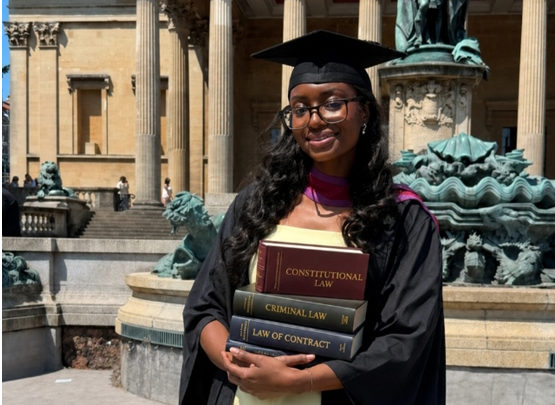
Last week, precisely on Monday, 13 July 2026, history was made at the University of Bristol in the United Kingdom, where Miss Olive Amarachi Igbokwuwe, an Akalite based in the UK with her parents and siblings, graduated with First Class Honours in Law. She spoke to Umuaka Times correspondents in the United Kingdom on various issues about her career, law and the society.

Excerpts:

Congratulations for the feat you achieved. May we meet you?
Yes of course! Thank you so much for having me!
Ok. What inspired you to read law?
I was inspired to study law while completing my Extended Project Qualification (EPQ), where I conducted research on the Human Rights Act 1998 in the UK.
What followed then?
As I explored the subject, I became fascinated by how the law shapes society and influences so many aspects of everyday life, from protecting individual rights to governing the way institutions operate. The more I researched, the more I realized how central the law is to almost everything we do. That experience sparked my passion for the subject and inspired me to apply to study law at university.
Oh my God. That is amazing indeed. How was the journey like? How stressful?
The journey was definitely a bit stressful, as applying to study law in the UK is often more rigorous than applying for many other degree courses. To be competitive for the top law schools, including those I was aiming for, you generally need excellent A-level grades, often around A*AA.
Is there any other requirement?
Another important part of the application is the personal statement, where you need to demonstrate a genuine and well-evidenced interest in law. Alongside studying for my A levels, I made a conscious effort to deepen my understanding of the subject by reading legal books, researching current legal issues, and attending university taster lectures. I wanted to ensure that my application reflected both my passion for law and my commitment to pursuing it.
Tell us more on what made the process extremely challenging.
What made the process particularly challenging was preparing for the LNAT (Law National Aptitude Test), which is required by many leading UK universities, including the University of Bristol. The test involved practicing multiple-choice questions designed to assess critical thinking and legal aptitude, as well as writing essays on unfamiliar topics under timed conditions. Preparing for this while balancing my A-level studies was demanding, but it taught me discipline, resilience, and the importance of consistent preparation.
- What was the biggest challenge you had as a student reading law?
One of the biggest challenges of studying law was the sheer volume of reading. In my first year alone, I had to prepare for six modules at the same time, which was a significant jump from A levels. Each module came with extensive reading lists, and the material was not only substantial but often complex and academically challenging. It wasn’t simply a case of reading quickly—you had to carefully analyze cases, legislation and academic commentary, which took time to fully understand and digest.
Was there any other?
Another challenge was achieving high marks, particularly in the early stages of the degree. At Bristol, we even had a running joke among law students that first-class marks were almost impossible to achieve because of how demanding the marking standards were. It took time to adjust to university expectations and to develop the analytical thinking and essay-writing skills that law requires.

Miss Olive Amarachi Igbokwuwe,Uba (University of Bristol) and Miss Nwamba Mercy Ngozi Umuele (UNN). Two young Umuaka girls who made First Class Honours in Law.
So, what were the new developments as you went on with your studies?
As I progressed through my degree, I learned how to construct stronger legal arguments, write more effectively and approach exam questions strategically. That persistence and willingness to improve ultimately paid off, showing me that success in law is built through continuous learning and resilience rather than talent alone.
Ok. What does it take to make First Class?
Achieving a First-Class degree takes much more than simply working hard—it requires consistency, discipline and genuine curiosity about the subject. Time management was one of the most important skills. Law involves a significant amount of reading, so staying on top of the workload and preparing for seminars well in advance is essential. Good preparation also allows you to engage more meaningfully in discussions, ask questions about areas you don’t understand, and identify when you need additional support. If I was still unsure about a topic, I would book office hours with my lecturers to deepen my understanding rather than leaving gaps in my knowledge.
I guess you were intellectually curious.
Yes indeed. I also found that intellectual curiosity makes a real difference. It’s much easier to excel in modules that genuinely interest you because you’re naturally more motivated to explore them in greater depth. Many of my First-Class marks came from going beyond the essential reading lists and completing the recommended further reading. Doing so gave me a broader understanding of the subject and enabled me to produce more sophisticated and well-supported arguments in my coursework and exams. Finally, strong essay-writing skills are crucial. A high-scoring law essay isn’t just a summary of the law—it needs to present a clear, well-reasoned argument supported by thorough legal research. Learning how to take a persuasive stance, critically engage with different viewpoints and reference sources accurately were all key factors in improving my grades throughout my degree.
You indeed climbed a lot of legal mountains. Who are your idols in law?
I wouldn’t really say I had any legal role models per se but I did look up to Mary Grace O who was a trainee solicitor at Clifford Chance during my application process to the firm.
Would you like to practice by arguing cases in court or do you prefer corporate practice?
Both by God’s Grace! Although the role of a solicitor in the UK is generally more focused on advising clients and managing legal matters than appearing in court, advocacy is something that has always interested me. In the future, I would love to qualify for Higher Rights of Audience, which would allow me, once qualified as a solicitor, to represent clients in the higher courts. When I begin my Training Contract at Clifford Chance, one of the practice areas I am particularly keen to experience is Litigation and Dispute Resolution.
What do trainees do?
While trainees do not usually conduct courtroom advocacy themselves, they play an important role in supporting the litigation process through legal research, preparing case documents, drafting submissions, coordinating evidence, and helping the legal team prepare for hearings and trials. I find the strategic and analytical side of resolving complex disputes incredibly interesting, and I hope to build on that experience throughout my career. If the opportunity arose later on, I would welcome the chance to combine that work with courtroom advocacy by obtaining Higher Rights of Audience.
There are many girls in Umuaka who wish to read law, what do you advise them?
My advice to any young girl in Umuaka who dreams of studying law is to first have a clear vision of what you want to achieve.
Why did you say so?
Habakkuk 2:2 says, “Write the vision and make it plain.” I believe there is great wisdom in setting your goals clearly, writing them down, and working towards them with purpose. Once you know where you want to go, you can break that vision into achievable steps and remain focused, even when the journey becomes challenging. I would also encourage them to work hard and be consistent. Success in law is not about being the smartest person in the room, but about discipline, perseverance and a willingness to keep learning. There will be setbacks and moments when you doubt yourself, but don’t let those moments define you. Above all, rely on God’s strength throughout the journey. There were times when the workload felt overwhelming, but my faith reminded me that I did not have to rely on my own strength alone. With prayer, dedication and perseverance, what may seem impossible today can become a reality tomorrow.
What could you have read if you didn’t read law?
English Literature, I took it as an A Level and enjoyed it.
Let’s hear this from you. If you are given an opportunity to advocate reforms in academic law practice or teaching, tell us what will be your advocacy.
If I had the opportunity to advocate for reforms in legal education and the profession, one of my main priorities would be improving accessibility for students from disadvantaged backgrounds. Law is an incredibly rewarding profession, but it is also highly competitive. Many talented students may not have the same access to mentoring, work experience, professional networks or financial resources, which can make entering the profession more difficult. I would like to see greater efforts to ensure that ability, dedication and potential are the factors that determine success, rather than a person’s background or circumstances. I would also advocate for making legal education even more accessible and inclusive. While legal terminology, including the use of Latin phrases, forms an important part of the law’s history and precision, it can sometimes make the subject feel intimidating or exclusive to those who are new to it. I believe we should preserve the richness of legal language while placing greater emphasis on explaining complex concepts in a way that is clear and accessible.
You sincerely believe all these will bring a positive change?
Doing so would help more students engage confidently with the law without lowering academic standards. Ultimately, I believe the legal profession is strongest when it reflects the diversity of the communities it serves, and creating more accessible pathways into both legal education and legal practice benefits not only aspiring lawyers but society as a whole.
There must be some people who were instrumental in your academic sojourn, please say hi to them.
My family, Chief Engr. Emmanuel NwokeojiIgbokwuwe, Lolo Nkiruka Georgina Igbokwuwe Emmanuel UchennaIgbokwuwe Engr Virtue ChiamakaIgbokwuwe and Jeffrey IfeanyichukwuIgbokwuwe. They provided me with utmost support throughout my academic journey, I couldn’t have done it without them! I heartily express my appreciation to Editor-in-Chief of Umuaka Times (Mr. Darlington OjyOnwukwe) and his team. I also use this opportunity to thank everyone for their prayers, support and congratulatory messages.
Congratulations once again on your new role!
Thanks a lot.