Umuaka Community Alleges Marginalization by Njaba LGA.
4 min read
Residents of Umuaka in Njaba Local Government Area of Imo State have raised strong concerns over what they describe as sustained marginalization by the current administration, led by Chief Vitals Obi. The community alleges systemic neglect despite being the highest contributor to the local government’s internally generated revenue.

In a wave of growing discontent, community members are questioning what they perceive as disproportionate control of key local government functions by individuals from communities not known to Umuaka. The sentiment, increasingly echoed among stakeholders, is captured in a pointed question now circulating widely: whether Njaba LGA is being run “as a government of a particular community, by the community and for the community.”

According to multiple local sources, an individual identified as Obikaeze Anaemem is reportedly overseeing the collection of levies per trip of sand across beach sites in the area. The same individual is also alleged to be in charge of street naming processes, with claims that residents are required to pay substantial sums ranging from hundreds of thousands and above to have streets and roads named after them.
In a related development, Pastor Odinaka Lebechi is said to wield significant influence within the local government, reportedly supervising a wide range of administrative functions. He is also alleged to play a role in overseeing security matters within the council.
Meanwhile, Oyo Ejikeme has been identified by sources as being responsible for urban planning activities in Njaba. Residents allege that individuals are required to pay considerable fees before being granted permission to build on their ancestral lands.
These claims, though yet to be independently verified by official authorities, have sparked debate within the community, with some residents calling for greater accountability and oversight in the management of local government affairs. Efforts to reach the individuals mentioned and local government officials for comment were unsuccessful at the time of filing this report.
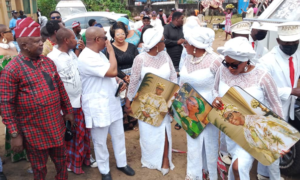
The controversy intensified following events on Saturday, April 11, 2026, during a grand reception held for the council chairman at the local government headquarters. According to multiple accounts, Afor Umuaka market was ordered shut for the occasion while Eke Okwudor, the market in the host community remained open. Traders and stakeholders at the market claimed the directive came from the local government authorities in honour of the chairman.
The reported closure of the major economic hub in the local council has since become a focal point of the grievances. Critics argue that the decision underscores a pattern of disregard for Umuaka’s economic interests and autonomy.
Adding weight to the claims, a former chairman of Njaba LGA, High Chief Eddy Ikwubuo, reportedly confirmed in a circulated voice note that the market closure was indeed carried out on the directive of the current administration.
As of now, Chief Vitals Obi has not publicly addressed the allegations or responded to calls for clarification regarding both the claims of marginalization and the market shutdown.
Community leaders warn that patience within Umuaka may be gradually wearing thin. There are growing indications that the issue could influence political alignments and decisions ahead of the 2027 elections if grievances remain unresolved.
Observers note that without timely dialogue, transparency, and equitable distribution of governance responsibilities, the situation risks escalating into a deeper political and social divide within Njaba LGA. Umuaka Times has therefore called for an urgent intervention.
With regards to the above, several voices in Umuaka have outlined their expectations from Njaba LGA in terms of basic infrastructure. Umuaka Times observes that residents are seriously expecting the delivery of basic infrastructure and essential services, emphasizing the need for visible and sustained improvements across the community.
At the forefront is the demand for better local road construction and maintenance. Community members expect regular grading of rural roads, proper drainage systems to prevent flooding, and functional street lighting to improve safety and mobility, especially at night in Umuaka. The clearing of blocked gutters remains a pressing concern, particularly during the rainy season.
In the area of primary healthcare, Umuaka people are calling for fully operational primary health centres equipped to provide essential services such as immunization, maternal care, and first-line treatment. For many residents, these centres represent the most accessible form of healthcare, making their efficiency critical.
Umuaka Times gathered that education support is another key expectation. Locals want improved maintenance of primary school buildings, better learning environments for children, and consistent collaboration between local and state authorities to ensure schools are not neglected.
Till date, sanitation remains a visible challenge in Njaba LGA especially in Umuaka where there is a heavy population. Residents insist that the local government must take stronger responsibility for waste management, including regular refuse collection and maintaining cleanliness in markets and public spaces. A cleaner environment is seen as essential for public health and community pride.

Access to clean water is also a major concern. The community expects the provision and maintenance of boreholes and other safe water sources to reduce reliance on unsafe alternatives.
Economic activities in Umuaka depend heavily on local infrastructure, prompting calls for improved markets and motor parks. Residents want well-organized, properly maintained spaces that can support traders, transport operators, and small businesses while also boosting internally generated revenue for the LGA.
Finally, the community highlights the importance of civil registration services, including the proper documentation of births, deaths, and marriages. Efficient record-keeping is seen as vital for planning, identity management, and access to government services. Unfortunately none of these services is provided in Umuaka.
In concrete terms, the people of Umuaka are urging Njaba Local Government to translate its statutory responsibilities into tangible, visible improvements that directly impact on the lives of the people. Njaba has no reason to complain, considering the huge allocations the local council receives monthly from the Federal Government of Nigeria and other sources of revenue.